Binance captures a major share of August crypto inflows
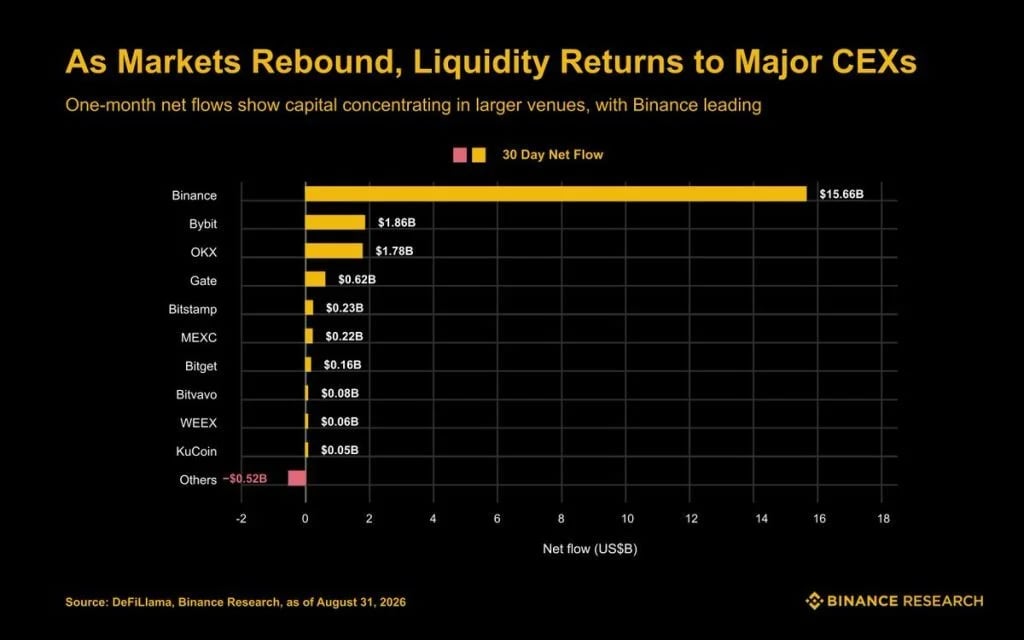
Binance ended August with a major increase in liquidity as cryptocurrency markets recovered and Bitcoin regained momentum. According to Binance Research, the exchange recorded approximately $15.7 billion in liquidity inflows during August, making it the largest recipient among centralized crypto exchanges.
The inflow figure came during a broader rebound in digital assets. Bitcoin climbed more than 20% during the month and moved above the closely watched $80,000 level. Market data shows Bitcoin reached above $80,000 during the August rally before retreating toward the end of the month.
The scale of Binance's inflows was particularly notable compared with other centralized exchanges. Binance Research said the exchange captured more than 75% of centralized exchange inflows, highlighting the concentration of liquidity among the industry's largest trading platforms.
Binance's inflows far exceeded competitors
The August figures show a substantial gap between Binance and other major centralized exchanges.
Binance Research reported that its $15.7 billion inflow was approximately 8.4 times larger than the second-largest positive inflow during the period. Bybit and OKX were also among the exchanges attracting significant liquidity, but Binance remained clearly ahead.
The concentration suggests that traders and investors continued to favor the largest venues as market activity increased. Binance Research described flows at smaller platforms as more mixed and fragmented, indicating that the market's liquidity was not distributed evenly across centralized exchanges.
The result also builds on Binance's relative resilience in July. While some exchanges experienced weaker flows or reduced operations, Binance remained among the platforms recording positive month-to-date inflows.
Bitcoin's rally helped revive exchange activity
Bitcoin's August recovery provided an important backdrop for the surge in exchange liquidity.
Bitcoin entered August at significantly lower levels before accelerating during the second half of the month. It eventually moved above $80,000, with market data showing an August high above $81,000.
The broader market recovery also increased activity across digital assets. As prices rise, traders may become more active in spot markets, derivatives and other crypto products, potentially increasing the amount of capital moving through centralized exchanges. However, the available figures do not establish that every dollar of Binance's $15.7 billion inflow was directly caused by Bitcoin's price increase.
The distinction is important because exchange inflows can represent multiple types of activity, including deposits, trading liquidity and transfers between platforms. Binance Research's figure therefore provides a measure of liquidity movement rather than a direct measure of net investor purchases.
Binance continues expanding beyond traditional crypto trading
Binance's position in the market comes as major cryptocurrency exchanges increasingly broaden the products available to users.
The company has been expanding its platform beyond traditional crypto trading, including efforts to provide access to additional financial products. This reflects a wider industry trend in which exchanges are attempting to become more comprehensive financial platforms rather than focusing exclusively on cryptocurrencies.
The expansion could allow users to manage different asset classes through a single interface, although the availability of individual products depends on the user's jurisdiction and applicable regulations. Binance's official platform provides information about the services currently available in different markets.
For Binance, maintaining a large liquidity base can also support its broader product strategy. High liquidity generally allows markets to process larger trading volumes with less price disruption, although liquidity conditions can change rapidly during periods of market stress.
Regulatory scrutiny remains part of Binance's story
Despite the strong August inflow figures, Binance continues to operate against a complicated regulatory backdrop.
The exchange has faced regulatory scrutiny in multiple jurisdictions as governments establish rules for digital asset platforms. The European Union's Markets in Crypto-Assets Regulation (MiCA) has introduced a common regulatory framework for crypto-asset service providers operating in the bloc.
Binance has previously adjusted its European operations in response to regulatory requirements. Users should therefore distinguish between Binance's global platform and the specific services available in individual countries. Regulatory authorization and product availability can vary significantly by jurisdiction.
The strong August inflows do not remove those regulatory challenges. Instead, the data shows that Binance continued to attract substantial liquidity while the exchange industry simultaneously adapts to increasingly detailed compliance requirements.
What the $15.7 billion figure means for the crypto market
Binance's August performance highlights how quickly exchange liquidity can change when cryptocurrency prices recover.
More than $15.7 billion in inflows gives Binance a substantial lead over competing centralized exchanges and reinforces its position as one of the industry's largest liquidity hubs. The figure also arrived during one of Bitcoin's strongest monthly rebounds of 2026, when the cryptocurrency briefly moved above $80,000.
However, the inflow number should not be interpreted as $15.7 billion of new money permanently entering crypto markets. Exchange liquidity can move between platforms, assets and trading products, meaning inflow statistics do not necessarily equal net purchases of cryptocurrencies.
For traders and market observers, the more important takeaway is the concentration of activity. Binance accounted for more than three-quarters of the centralized-exchange inflows reported by Binance Research, while Bybit and OKX followed at a much smaller scale.
Binance enters September with strong liquidity momentum
August provided Binance with a significant liquidity boost as Bitcoin and the broader crypto market recovered. The exchange's $15.7 billion inflow figure was substantially larger than the next-best centralized exchange result and represented more than 75% of the ecosystem inflows cited by Binance Research.
Bitcoin's move above $80,000 helped create a stronger market backdrop, while the concentration of liquidity at major exchanges showed that investors continued to rely heavily on established trading venues.
Whether that momentum continues into September will depend on market prices, trading activity, liquidity conditions and the evolving regulatory environment. For now, August stands out as a particularly strong month for Binance and centralized crypto-market liquidity.