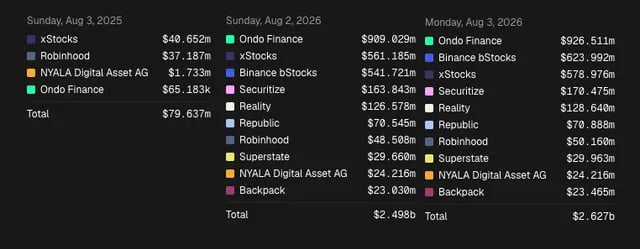
According to Token Terminal's tokenized-asset data, bStocks reached approximately $624 million in market value on Aug. 3, moving ahead of xStocks at roughly $579 million.
Ondo Finance remained the largest issuer at approximately $927 million at that point.
As of the latest figures cited in the original data, bStocks stood at about $610.6 million, narrowly ahead of xStocks at approximately $601.2 million.
Token Terminal's tokenized-assets dashboard tracks market capitalization across tokenized stocks and other real-world assets.
bStocks Gains Ground Quickly After Launch
Binance launched bStocks on June 11, 2026, initially offering tokenized exposure to a limited number of equities.
The product has expanded rapidly since launch.
Binance said in late July that bStocks had surpassed $500 million in assets under management only seven weeks after launch, while the number of available listings had grown from five to more than 46.
The rapid increase reflects growing interest in bringing traditional financial assets onto blockchain infrastructure.
Unlike traditional equity markets, tokenized securities can potentially provide users with blockchain-native features such as around-the-clock trading, faster settlement and self-custody, depending on the product and jurisdiction.
bStocks Are Built on BNB Smart Chain
The connection to BNB Smart Chain is particularly important for your BSC audience.
Binance states that bStocks are issued as BEP-20 tokens on BNB Smart Chain, allowing compatible users to withdraw them to supported wallets and use them with blockchain applications.
That gives tokenized stocks a direct connection to the BNB Chain ecosystem.
Instead of remaining solely within a centralized exchange environment, eligible bStocks can interact with compatible on-chain infrastructure.
Binance also says bStocks can be used across decentralized finance applications, including potential lending and other DeFi use cases where supported.
This makes tokenized equities part of the broader real-world asset (RWA) narrative on BNB Chain.
How Binance bStocks Work
bStocks are not the same as directly owning shares through a traditional brokerage account.
According to Binance, each bStock is backed 1:1 by a corresponding U.S. share held with a regulated custodian.
The tokens are issued by BTech Holdings Limited, a Binance group affiliate.
Eligible users receive economic exposure to the underlying stock through the tokenized product, while the underlying shares remain held by the designated custodian.
Binance also says users can convert between eligible underlying stocks and their corresponding bStocks at a 1:1 ratio, subject to applicable terms and eligibility requirements.
That structure is designed to connect traditional equities with blockchain-based financial infrastructure.
Tokenized Stocks Bring Traditional Assets On-Chain
The growth of bStocks is part of a broader expansion in tokenized real-world assets.
Tokenized stocks represent traditional financial exposure through blockchain-based tokens.
The model can potentially provide several advantages compared with traditional market infrastructure, including:
24/7 trading
Faster settlement
Fractional access
Blockchain-based transfers
Self-custody where supported
Potential DeFi composability
Binance says bStocks can provide fractional exposure starting from $5, making the product accessible to users who may not want to purchase a full traditional share.
However, tokenized securities remain subject to jurisdictional restrictions and product-specific requirements.
bStocks Strengthen BNB Chain's RWA Narrative
The rapid growth of bStocks could have implications beyond Binance itself.
BNB Smart Chain has increasingly positioned itself as infrastructure for DeFi, decentralized applications and real-world assets.
Binance's own BNB Chain overview describes BNB Smart Chain as the EVM-compatible layer of the BNB Chain ecosystem designed to support decentralized applications and DeFi.
Tokenized equities add another category of assets that can potentially interact with that infrastructure.
Instead of limiting blockchain-based financial activity to cryptocurrencies and stablecoins, RWAs allow traditional financial instruments to become part of on-chain markets.
bStocks vs. Traditional Stocks
One important distinction is that a bStock does not represent direct legal ownership of the underlying company shares.
Binance explicitly states that bStocks are structured as certificates representing financial instruments rather than direct shares in the underlying company.
This distinction matters because token holders may receive economic exposure without receiving the same shareholder rights associated with directly owning the underlying equity.
For example, tokenized products may not provide traditional voting rights.
Users also need to consider jurisdictional eligibility, custody arrangements, conversion rules and the risks associated with the underlying stock.
The Tokenized Stock Market Is Growing
The broader tokenized-stock market has expanded dramatically compared with a year ago.
Token Terminal introduced its tokenized-assets dataset to track the growth of stablecoins, tokenized funds and tokenized stocks across issuers and blockchain networks.
The increasing competition between Binance bStocks, xStocks and Ondo highlights how quickly this market is developing.
The race is no longer limited to crypto-native protocols.
Exchanges, fintech companies and financial infrastructure providers are increasingly competing to bring traditional assets onto blockchain networks.
What bStocks Could Mean for BNB Chain DeFi
The most important development for the BNB Chain ecosystem may be what happens after tokenized stocks are issued.
If tokenized equities become widely available across decentralized applications, they could potentially be used as collateral, incorporated into structured products or paired with other assets in DeFi markets.
That could expand the types of financial assets available within BNB Chain's on-chain economy.
However, these use cases depend on liquidity, regulatory permissions, smart-contract infrastructure and support from individual DeFi protocols.
The existence of a tokenized stock does not automatically mean it can be used across every BNB Chain application.
Binance bStocks Continue to Gain Momentum
Binance bStocks' rapid rise into the second position among tokenized stock issuers demonstrates the growing demand for blockchain-based access to traditional financial markets.
More importantly for BNB Chain, the products are issued as BEP-20 tokens on BNB Smart Chain, connecting tokenized equities directly with the network's wallet and DeFi infrastructure.
If tokenized stocks continue attracting liquidity and users, real-world assets could become an increasingly important part of BNB Chain's ecosystem.
For now, the competition between bStocks, xStocks and other tokenized-equity platforms is still developing.
But Binance's rapid growth suggests that tokenized stocks could become one of the major RWA use cases driving the next phase of BNB Chain adoption.