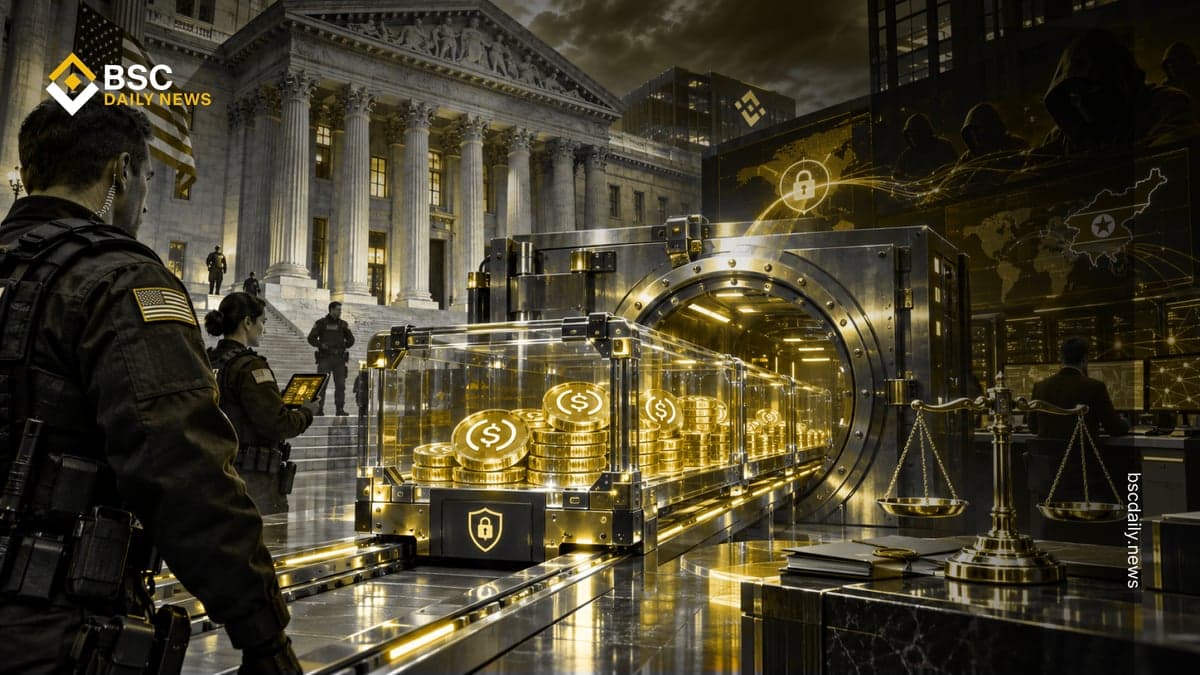
The US Department of Justice (DOJ) has launched a civil forfeiture action targeting more than $1.1 billion in cryptocurrency stolen from Binance in an October 2026 attack attributed to North Korean cyber actors. The move marks another step in an international effort to recover assets from one of the largest cryptocurrency thefts on record.
In a November 23 court filing, prosecutors asked the US District Court for the District of Columbia to forfeit USDC associated with 36 cryptocurrency addresses across 18 blockchain networks. The targeted stablecoin was issued by Circle and is linked to funds stolen during the October 29 breach.
The DOJ said the United States has helped freeze, seize or recover almost $3 billion in cryptocurrency since the incident. The government is pursuing the forfeiture as part of a broader effort to assist Binance in recovering more than $6 billion in stolen assets.
The DOJ announcement confirmed that the FBI, US Secret Service and IRS Criminal Investigation are investigating the theft. Circle also provided assistance to authorities.
DOJ Targets USDC Across 18 Blockchain Networks
The civil complaint identifies the assets targeted for forfeiture as USDC connected to 36 virtual currency addresses spread across 18 blockchain networks. These include Ethereum, Solana, Polygon, Arbitrum, Avalanche, Base, Optimism, Celo, Sei and several other networks.
The filing describes the targeted funds as proceeds of the Binance theft and assets that were subsequently laundered. It also explains that Circle has the technical ability to block individual addresses from sending or receiving USDC on supported networks.
According to the complaint, Circle voluntarily restricted access to the identified USDC addresses. However, the company told the government that it cannot directly transfer the blocklisted tokens from addresses controlled by the attackers.
Instead, Circle agreed to issue an equivalent amount of new USDC and transfer those replacement tokens to the United States if the court grants a final forfeiture order. This arrangement means the government's recovery effort depends on the outcome of the civil proceedings.
The filing is a request for forfeiture, not a final ruling that permanently transfers ownership of the assets to the government. The court must still determine whether the requested forfeiture can proceed.
The full verified forfeiture complaint provides the addresses, blockchain networks and legal basis for the action.
FBI Attributes the Attack to North Korean Cyber Actors
US authorities have linked the Binance theft to North Korean hacking operations. The FBI identifies the specific activity as TraderTraitor, a designation it uses for malicious cyber activity attributed to North Korea.
The DOJ complaint separately assesses that members of North Korean military hacking groups known as the Lazarus Group and Advanced Persistent Threat 38 (APT38) were responsible. Investigators based that assessment on technical indicators associated with the breach and the methods used to move the stolen funds.
The court filing also provides details about how the attackers allegedly gained access to Binance's systems. Binance informed law enforcement that the compromise most likely involved an employee who was contacted by someone posing as a job recruiter.
The employee agreed to an interview and was instructed to download software. That software contained malware, which compromised the employee's device and allowed the attackers to install an EIP-7702 injection.
EIP-7702 is an Ethereum feature introduced in a 2025 network update. It allows externally owned accounts to temporarily use smart-contract functionality. The complaint says the attackers exploited this mechanism to take control of Binance hot wallets and use a sweeper contract to transfer funds automatically.
The FBI's public alert identifies the North Korean connection and provides cryptocurrency addresses associated with the activity.
At Least $247 Million Moved Through Bitcoin Mixers
The legal action comes as investigators continue tracking the movement of stolen assets across multiple blockchains. Elliptic's analysis, updated November 23, found that at least 3,930 Bitcoin, valued at approximately $247 million, had entered CoinJoin transactions.
CoinJoin is a Bitcoin transaction method that combines inputs from multiple users into a shared transaction. This makes it more difficult for outside observers to determine which outgoing funds belong to which original participants.
Elliptic identified activity involving more than 27,000 wallets across at least 16 blockchains and approximately 55 services. The investigation also tracked around 90,000 transactions connected to the theft.
The firm's November 23 update estimated that approximately $2.22 billion remained in addresses linked to the attack. It also found that the 18,270 BTC stolen directly from Binance had not moved since being distributed across 19 addresses on the night of the breach.
The Bitcoin entering mixing transactions came from other stolen assets that had been converted into BTC, primarily through movements involving ETH, XRP, SOL and TRX. Elliptic said much of the stolen cryptocurrency had changed form or moved between addresses, but there was limited evidence that the funds had been converted into cash.
These figures reflect a developing investigation and can change as additional transactions are identified. Elliptic's Binance theft tracking analysis details the movement of funds and the techniques used to make tracing more difficult.
Binance Pursues Legal Recovery of Stolen Assets
Binance has also taken legal steps to recover cryptocurrency connected to the attack. On November 18, the exchange announced that it had obtained a worldwide freezing order from the Abu Dhabi Global Market (ADGM) Courts.
The order targets the alleged attackers and supports efforts to prevent them from accessing assets held by exchanges, issuers and other service providers. Binance said the legal action creates a formal process through which partners can help return frozen funds.
The exchange has also stated that customers would not bear the financial impact of the incident. In its November 3 security update, Binance said approximately $6.34 billion in digital assets had been affected and that around $2.85 billion had been frozen or intercepted at that point, subject to reconciliation and market-price changes.
Binance said it had committed more than the amount needed to cover the losses and was working with law enforcement, blockchain intelligence firms and industry partners to trace and freeze the stolen assets.
Its November 18 court-order announcement outlined the legal recovery effort, while its security incident update detailed the exchange's response.
The DOJ's forfeiture action adds another legal route for recovering assets, particularly the USDC already restricted by Circle. However, the wider recovery effort remains ongoing as investigators follow funds moving across wallets, blockchains and mixing services.