BSC plans reserved blockspace for payment transactions
BNB Smart Chain (BSC) is preparing a new Payment Lane mechanism designed to keep payment-related transactions moving when the network experiences periods of heavy demand.
The proposed system would reserve a minimum amount of block gas for qualifying payments instead of allowing those transactions to compete entirely with other activity during congestion. According to the provided BSC proposal, the feature is planned for Q4 2026.
The approach focuses on a specific problem: payments can be time-sensitive, but they currently share blockspace with every other type of transaction. BNB Chain has previously acknowledged that traffic spikes can lead to transactions not being included as quickly as expected.
The Payment Lane is intended to address that issue without creating a separate transaction-ordering system or changing how decentralized exchange activity and maximal extractable value (MEV) operate.
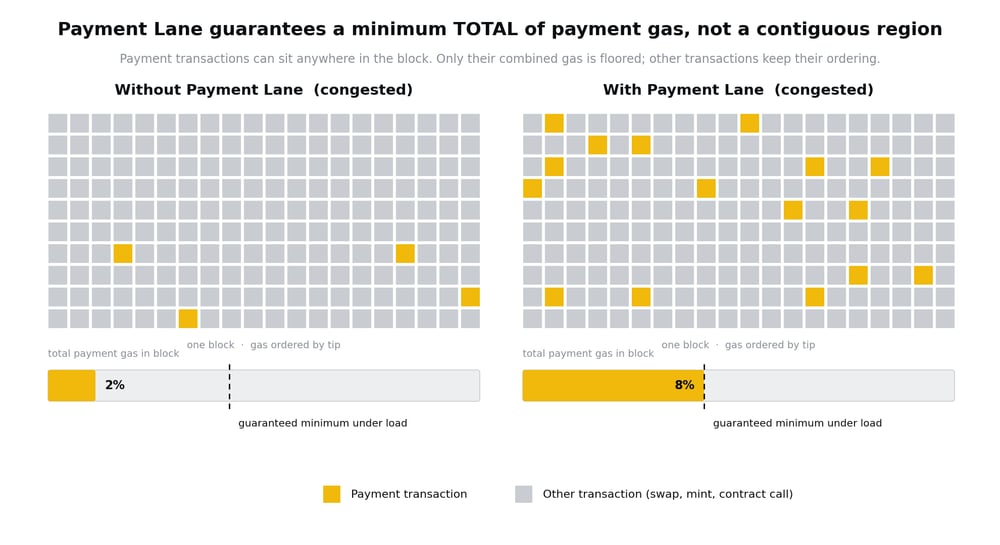
Why congestion can affect payments
BSC transactions generally compete for inclusion in blocks, with priority fees playing an important role in determining transaction priority. Under normal network conditions, this system can process different types of activity efficiently.
The situation can change when demand suddenly increases. A major token launch, speculative trading activity or another high-volume event can consume significant blockspace. As a result, ordinary transfers such as exchange withdrawals, remittances and merchant payments can face delays even when they are unrelated to the activity creating the congestion.
Payment activity is also widespread across BSC. The material provided for the Payment Lane states that payment transactions appear in approximately 99.6% of BSC blocks. Although these transfers generally consume relatively little gas, delays can still matter when the transaction involves moving funds between users, businesses or financial platforms.
BSC has already been working on network performance. The Pasteur hardfork was deployed on August 25, 2026, and BNB Chain's release documentation identifies the upgrade as the BSC mainnet Pasteur hardfork.
Payment Lane therefore targets a different part of the problem: how existing blockspace is allocated when demand becomes unusually high.
How the BSC Payment Lane would work
The core idea is a minimum blockspace floor for eligible payment transactions.
Rather than creating a physically separate portion of every block, the mechanism would track the gas consumed by qualifying payments through a parameter called PaymentGasLimit. During congestion, the protocol would ensure that qualifying payment activity receives at least the configured minimum amount of block gas.
The proposed system has three important characteristics:
A floor rather than a ceiling: eligible payments receive minimum guaranteed capacity but can still use additional available space.
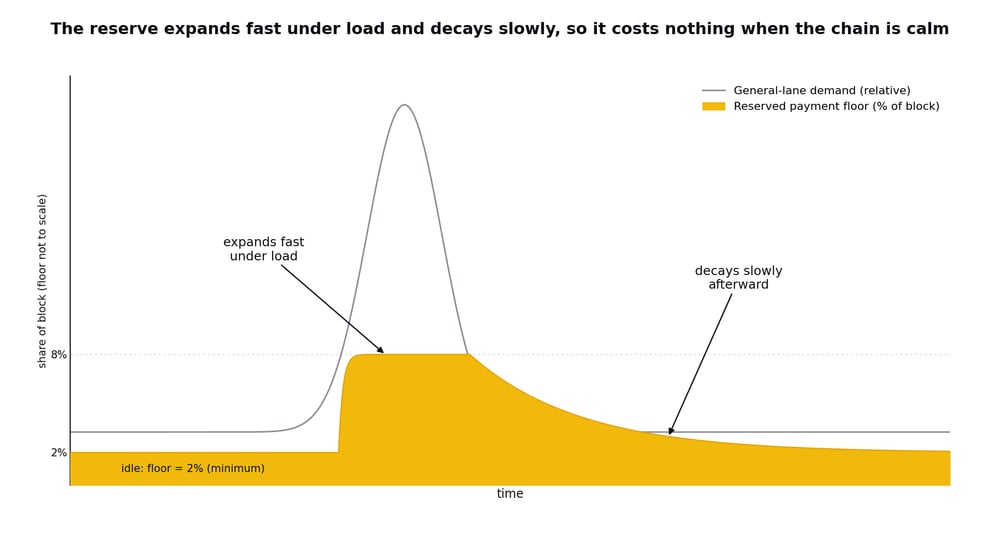
Dynamic allocation: the reserve can increase when congestion rises and decrease when demand falls.
Limited scope: the mechanism is intended specifically for qualifying payments rather than general transaction activity.
This means Payment Lane would not create a completely separate payment blockchain or require wallets to use a new transaction type.
BSC's existing architecture already includes mechanisms for transaction bundling, block building and MEV. BNB Chain's documentation explains that builders assemble transactions into blocks and validators select among block bids.
Which transactions qualify?
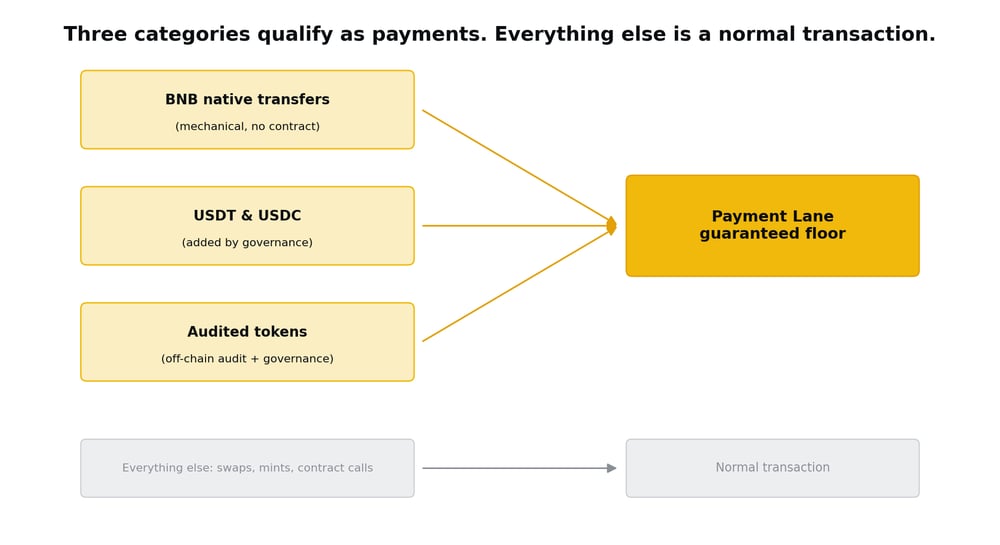
The proposal identifies three categories of transactions that could qualify for the payment reserve.
These include native BNB transfers, USDT and USDC transfers, and audited tokens approved through governance.
Other transaction types would continue to operate under the normal blockspace rules. This distinction is important because the objective is not to give every transaction priority. Instead, the system is narrowly focused on value-transfer activity that can be particularly sensitive to delays.
For users, the proposal says there would be no new flag or transaction type to select. Wallets and applications would therefore continue submitting transactions through the existing process.
That approach is consistent with BNB Chain's broader focus on improving the user experience around payments and transaction execution. The network already supports Paymaster infrastructure that can allow eligible users to have transaction fees sponsored by another party.
What stays unchanged for DeFi and MEV?
One of the key points of Payment Lane is that it is designed to operate without fundamentally changing the rest of BSC's transaction market.
Priority-fee ordering remains in place. Decentralized exchange swaps would continue competing for blockspace normally, while existing MEV-related mechanisms would also remain unchanged.
The reserve is therefore not intended to create a preferred lane for trading activity. Instead, it establishes a minimum amount of capacity for qualifying payment transactions during congestion.
BNB Chain's existing MEV documentation describes a system in which builders collect transactions and construct blocks, while proposers select the most profitable block from available bids.
Under the Payment Lane proposal, the economic impact would also be limited outside periods of congestion. When demand is normal, the reserve does not represent a new permanent blockspace allocation that would change ordinary fee or block-reward dynamics.
What Payment Lane could mean for users and businesses
If implemented as described, the mechanism could be particularly relevant to exchanges, wallets, remittance applications and merchant payment services operating on BSC.
For these services, reliability can be just as important as transaction cost. A transfer that is inexpensive but delayed during a period of market stress can create operational problems for businesses and users.
The proposal is also designed to avoid requiring application developers outside the payments sector to make changes. DeFi applications, trading platforms and other BSC builders would continue using the existing transaction and MEV infrastructure.
The broader issue is one BSC has faced as blockchain usage grows: maintaining predictable transaction execution when demand is uneven. BNB Chain's own documentation notes that congestion on blockchain networks can result in higher fees, slower transactions and a poorer user experience.
Governance and Q4 2026 rollout
Before the planned Q4 2026 launch, validators are expected to vote on important parameters, including the size of the payment reserve, congestion thresholds and how quickly the reserve should adjust.
This governance process will determine how aggressively the mechanism responds to changes in network demand.
The proposal therefore represents an infrastructure change rather than a new payment application. Its purpose is to modify how block capacity is protected for a narrow class of transactions while leaving the broader BSC transaction market intact.
If the planned parameters and rollout proceed as described, BSC Payment Lane could give payment providers a more predictable path for transfers during short-lived congestion without requiring users to learn a new transaction system.